Digital Arrest Scams — Why No Real Police Officer Will Ever Video-Call You
A video call flashes on your phone. The man on screen wears a police uniform. Behind him: a government office, a national emblem, case files. He says a parcel in your name was caught with drugs, or your Aadhaar was used for money laundering. You are now under "digital arrest" — you must stay on camera, tell no one, and transfer money for "verification" until your name is cleared.
Every word of it is a script. And in 2025 alone, scripts like this helped cyber criminals take an estimated ₹22,495 crore from Indians, with complaints to the national cybercrime portal jumping 24% to about 28 lakh cases, according to data from the Indian Cyber Crime Coordination Centre (I4C).
The one fact that defeats this scam
There is no such thing as a digital arrest in Indian law. Not under the Bharatiya Nagarik Suraksha Sanhita (BNSS), not under the IT Act, not anywhere.
No police force, CBI, ED, Customs, TRAI or court conducts arrests, investigations or "fund verification" over video calls or WhatsApp. Any such call is a scam — 100% of the time, no exceptions.
An actual arrest requires physical presence, a memo of arrest, and your right to inform a person of your choice. Real agencies never demand money to "settle" or "verify" a case — and they certainly do not accept UPI.
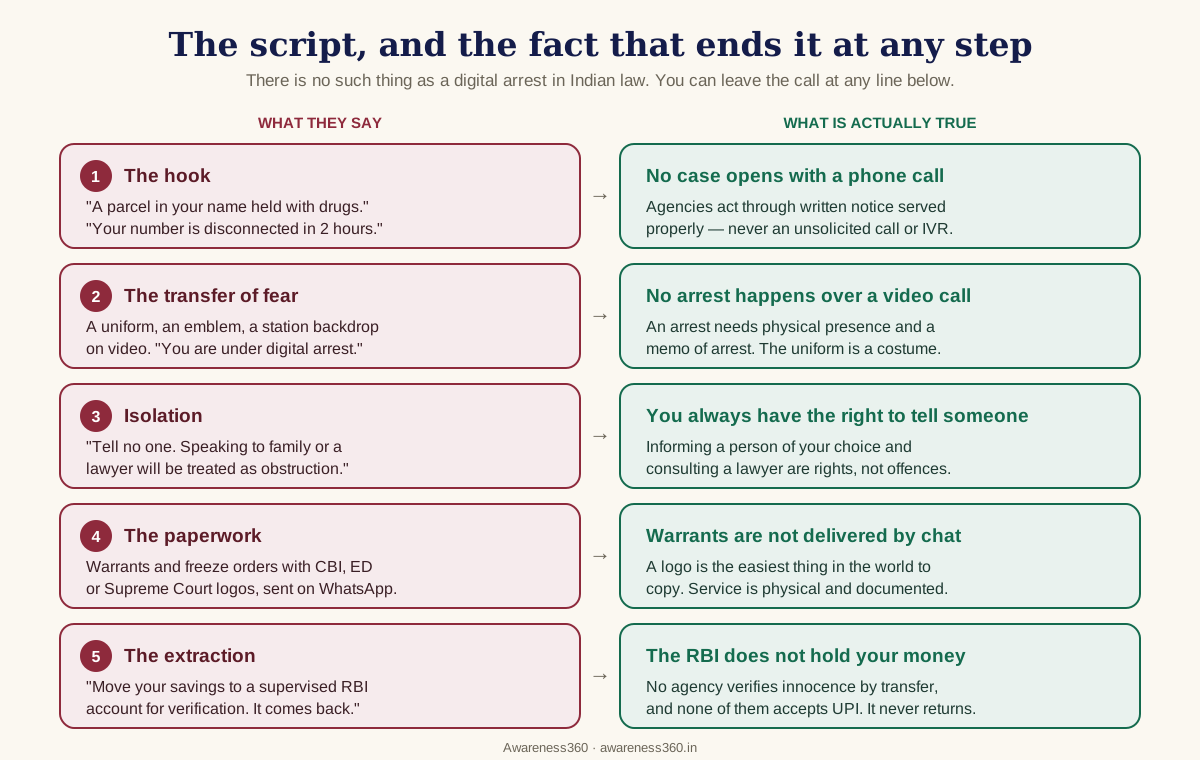
Read that as an escape map rather than a warning list. Three things follow from it:
- You can leave at any row. The script needs all five steps to work, so breaking any one of them ends it. Almost every victim describes a moment when something felt wrong — the map exists so that moment turns into hanging up rather than complying.
- What they know about you says nothing about who they are. Your name, address and Aadhaar digits circulate cheaply after data breaches, and step 1 is built to sound authentic. Accurate details confirm that your data leaked, not that the caller is real.
- Step 3 is the one to prepare for at home. Isolation is the only step that needs your cooperation over hours rather than seconds, and it is where a family rule beats any technical defence. Agreeing in advance that any call about police, parcels or money gets discussed with one named person collapses the whole sequence.
How the scam actually unfolds
- The hook. A call or IVR message claims a courier parcel with contraband, a SIM issued in your name used for crime, or "your number will be disconnected in 2 hours" (fake TRAI).
- The transfer of fear. You are "connected" to a fake police or CBI officer on a video call. Uniforms, wireless sets and station backdrops are all staged.
- Isolation. You are told the case is confidential — talking to family or a lawyer will be treated as "obstruction". Some victims are kept on camera for days.
- The fake documents. Arrest warrants and account-freeze orders with CBI, ED, RBI or Supreme Court logos arrive on WhatsApp. Real agencies never serve documents this way.
- The extraction. You are told to transfer your savings to a "supervised account" of the RBI or court for verification, to be "returned after the enquiry". It never returns.
Why it feels so real now
Fraud gangs — many operating from scam compounds abroad — have upgraded their tools. They use AI-generated voices, spoofed caller IDs that display genuine-looking numbers, and personal details harvested from data leaks, so the "officer" already knows your name, address and Aadhaar digits. Confidence in the details is not proof of authenticity; it is proof your data leaked.
Red flags: real procedure vs the scam script
| What they say | What actually happens |
|---|---|
| "You are under digital arrest — stay on camera" | No law allows arrest by video call |
| "Transfer funds for RBI verification" | RBI never holds or verifies personal funds |
| "Tell no one — the case is secret" | You always have the right to a lawyer and to inform family |
| "Warrant sent on WhatsApp" | Warrants are served physically through due process |
| "Pay now or be arrested tonight" | Urgency is the scammer's only real weapon |
If you get such a call
- Hang up. You cannot be punished for disconnecting a scam call. Do not press "1", do not call back.
- Never transfer money, share OTPs, or install any app the caller asks for.
- Report the number on the Chakshu facility at sancharsaathi.gov.in so it can be blocked.
- If you paid anything, call 1930 (National Cyber Crime Helpline) immediately and file a complaint at cybercrime.gov.in — the first hour matters most for freezing the money.
- Warn your parents and grandparents today. Retirees are the most targeted group because they are more likely to be home, alone, and reachable on video calls.
Most victims stay silent out of shame. Agreeing on one family rule — "any call about police, parcels or money gets discussed at home first" — defeats the isolation tactic that this entire scam depends on.
Protecting the people most likely to be targeted
The victims in this scam are rarely careless. They are overwhelmingly people who were raised to treat a uniform and an official-sounding voice as authority — which is precisely the instinct the script exploits. If you have retired parents or grandparents, a short conversation now is worth more than any app or setting.
- Give them permission to hang up. The core fear is that disconnecting on a "police officer" makes things worse. Say it plainly: hanging up on a scam call has no consequences, ever.
- Agree on a single family rule. Any call involving police, courts, parcels, arrests or money gets discussed with one named family member before anything happens. This one rule defeats the isolation step the whole scam depends on.
- Pre-empt the shame. Tell them in advance that if it ever happens, nobody will be angry. Most losses grow larger because the victim stays silent for hours out of embarrassment.
- Practise the sentence. "I'm going to hang up and call 1930 myself." Saying it once out loud makes it far easier to say under pressure.
If it is happening right now
- Disconnect. Not "later", not after one more explanation. The call has no legal weight, and there is no penalty for ending it.
- Do not install anything. Any request to install a screen-sharing, "verification" or "secure banking" app is an attempt to take control of your device and your accounts.
- Break the isolation immediately. Call one family member and say what happened. The scam only works while you are alone with it.
- If money has already moved, call 1930 straight away — before you try to work out how it happened. The first hour decides whether it can be frozen.
- Keep everything. Numbers, screenshots, the fake documents, the account details you were told to pay. Do not delete them in frustration; they are evidence.
The system is fighting back — slowly
Through 2025, authorities deactivated over 12 lakh SIM cards linked to fraud, froze more than 13 lakh mule bank accounts, and the 1930 helpline system has helped block or recover thousands of crores in transit. But enforcement always trails the scammers. Your fastest protection is not the system — it is knowing that "digital arrest" does not exist.
Frequently asked questions
Can I actually be arrested for hanging up on them?
No. There is no offence of "refusing a video call from an investigator", and no such thing as a digital arrest to begin with. If a genuine agency ever needs to reach you, it does so through documented, physical process — a written summons or notice served properly, not a call demanding you stay on camera.
They knew my name, address and Aadhaar digits. Doesn't that prove they're real?
It proves the opposite of what it feels like. Personal details circulate widely after data breaches, and scam operations buy them precisely so the opening minute sounds authentic. Knowing your details is the cheapest part of the script. A real investigator would not need you to confirm them over an unsolicited video call.
The caller ID showed a real police or government number. How?
Caller ID can be spoofed, so the number displayed on your phone is not evidence of who is calling. This is why the safe move is always to end the call and dial an official number yourself, from the organisation's own website — never a number the caller gives you, and never by returning their call.
I already transferred money. What now?
Call 1930 immediately, before anything else, then file at cybercrime.gov.in and inform your bank's fraud helpline. Speed is the entire game: money can be frozen while it is still moving through accounts, and the chance of that drops with every hour. Do not wait until you have pieced together exactly what happened.
They are threatening to arrest my family or leak my photos. Should I pay?
No. Paying confirms you are a paying victim and reliably produces further demands rather than ending them. Threats of this kind are part of the same script. Disconnect, keep the evidence, and report on 1930 and the cybercrime portal — and if the threats continue, take them to your local cyber police station.
Should I report it even if I lost no money?
Yes, and it takes a few minutes. Report the number through Chakshu on sancharsaathi.gov.in so it can be blocked. Reports from people who did not fall for it are how numbers get taken out of circulation before they reach someone who would have.
Do these scammers ever call back?
Often, sometimes from a different number and a different "agency" — and sometimes later as a "recovery agent" offering to get your money back for a fee. That is a second scam aimed at known victims. Block, do not engage, and deal only through 1930 and the official portal.
The bottom line
Fear and urgency are the entire scam. The moment anyone on a call claims you are under arrest, being investigated, or must move money to prove innocence — you already know everything you need to: it is fake. Hang up, report on 1930, and tell your family the same.
How this guide is made
Written and fact-checked by the Awareness360 editorial team from primary sources — RBI, SEBI, IRDAI, the Income Tax Department and Government of India portals — with links to the originals in the text above. Last reviewed on 12 Aug 2026. This is general educational information for Indian readers, not professional financial, legal or tax advice.
Spotted something out of date? Tell us and we'll correct it — see our editorial policy.