Scammed on UPI? The First 60 Minutes Decide If You Get Your Money Back
The moment fraud money leaves your account, a race begins. Scammers split it across layers of mule accounts — rented bank accounts of ordinary people — and cash it out through ATMs, wallets or crypto within hours. Report fast enough, and banks can freeze it mid-journey. The 1930 helpline ecosystem has already helped save over ₹7,000 crore this way across lakhs of complaints. Report late, and the trail is usually cold.
Here is exactly what to do, in order.
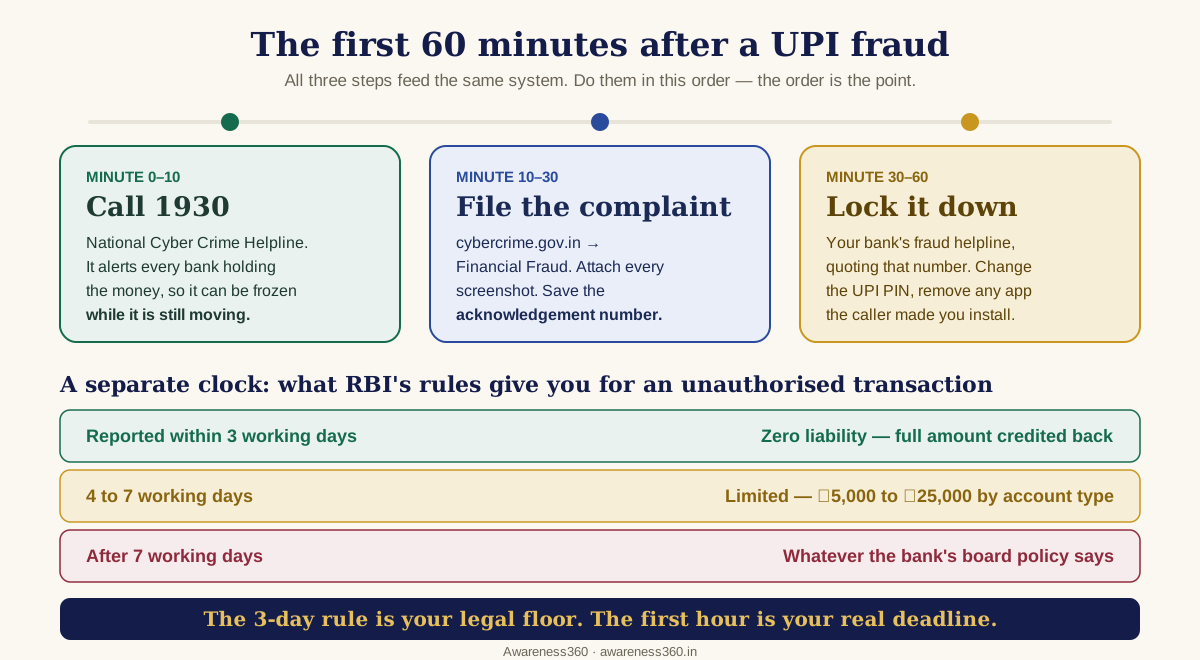
Two clocks start the moment the money leaves, and most people only know about one of them:
- The freeze clock runs in hours. It appears in no rulebook — it is simply how long the money takes to be split across mule accounts and cashed out. Nothing you do later can beat it, and the three steps above exist to race it.
- The liability clock runs in working days. This one is written down, and it decides who bears the loss on an unauthorised transaction. Three working days is the line that matters.
The trap is treating the second clock as your deadline. "I have three days" is true about your bank liability and completely false about your money — by day three, an amount nobody froze has usually gone.
Minute 0–10: Call 1930
Dial 1930 — the National Cyber Crime Helpline, connected to the Citizen Financial Cyber Fraud Reporting and Management System. It works in Hindi, English and regional languages, and it exists precisely for this moment.
Keep ready:
- Your phone number and the bank account/UPI ID debited
- The fraudster's UPI ID, account number or phone number (from the transaction record)
- Transaction ID(s), amount(s) and time — all visible in your UPI app's history
- What happened, in one or two lines
The system alerts the banks in the money trail, who can put a lien (freeze) on the amount wherever it currently sits.
Victims often first call the scammer back, then a relative, then the bank's general line. Every one of those calls burns the minutes that matter. 1930 first — everything else after.
Minute 10–30: File the written complaint
Go to cybercrime.gov.in and file under "Report Cyber Crime → Financial Fraud". Attach screenshots of the transactions and any chats or call logs. Note the acknowledgement number — you will need it for the bank and for any follow-up. The 1930 call and the portal complaint feed the same system; doing both makes your case complete.
Minute 30–60: Lock down your accounts
- Call your bank's fraud helpline (number is on the back of your debit card) — report the fraud, quote the acknowledgement number, and ask them to log it.
- If you shared your PIN, installed a screen-share app, or clicked a suspicious link: change your UPI PIN, uninstall the app, and consider temporarily disabling UPI from your bank's app.
- If your phone or SIM is compromised, contact your telecom operator — and report the fraud number on Chakshu at sancharsaathi.gov.in.
Your rights under RBI's zero-liability rules
For unauthorised transactions (money taken without your action — for example, a compromised account), RBI's customer-protection framework is clear:
| When you report | Your liability |
|---|---|
| Within 3 working days | Zero — full amount to be credited |
| 4 to 7 working days | Limited (₹5,000–₹25,000 depending on account type) |
| After 7 working days | As per the bank's board-approved policy |
Banks must credit "shadow reversal" of the disputed amount within 10 working days when zero-liability applies, and resolve the complaint within 90 days. If the bank stalls, escalate to its internal ombudsman and then to the RBI Banking Ombudsman via cms.rbi.org.in — it is free.
If you were tricked into pressing "Pay" yourself, the transaction is technically authorised, and zero-liability rules may not apply automatically. Recovery then depends on how fast the money was frozen — which is why 1930 in the first hour is everything.
How frozen money actually comes back
A freeze is not a refund. Once the amount is lien-marked in a mule account, refunds happen through the process in your state — many victims get orders through the local cyber police station or a magistrate's order directing the bank to reverse the frozen amount. Keep your acknowledgement number, respond when the cyber cell contacts you, and follow up periodically on the portal. It can take weeks to months — but frozen money is very often returned.
If you sent money to the wrong UPI ID by mistake
This is not fraud, and it follows a different path — but people search for it in the same panic, so it is worth knowing the distinction.
- Raise the complaint inside your UPI app first. Every UPI app carries a dispute or "raise concern" option against a specific transaction in its history. This is the formal entry point, and it is what starts the record.
- Escalate to your bank if the app route stalls, quoting the transaction reference (UTR) and the exact time.
- If the recipient's bank is different, your bank raises it with theirs. An unintended transfer cannot simply be pulled back — the money is legally in someone else's account, and reversing it needs their consent or an order.
- If it is still unresolved after 30 days, escalate free of charge to the RBI Banking Ombudsman at cms.rbi.org.in.
The uncomfortable truth: recovery depends heavily on whether the unintended recipient cooperates. Verify the name shown before confirming any large transfer — that one-second check is worth more than the entire process above.
When the bank pushes back
Banks do sometimes reject claims by classifying a fraud as "authorised by customer". You are not out of options.
- Get the rejection in writing, with the reason stated. A verbal refusal is not a decision you can escalate.
- Ask for the complaint reference and the internal ombudsman's response — banks above a certain size are required to have one, and a claim must go through it before the RBI stage.
- Then escalate to the RBI Banking Ombudsman at cms.rbi.org.in. It is free, it is online, and you do not need a lawyer.
- Keep the 1930 acknowledgement number in every submission. It is contemporaneous proof of when you reported, which is usually the fact the whole dispute turns on.
Frequently asked questions
Will my bank automatically refund UPI fraud?
Not automatically. Where the transaction was genuinely unauthorised and you reported within 3 working days, RBI's framework provides for zero liability and the amount to be credited back. But the classification is the fight: if the bank treats the payment as one you authorised, no automatic refund follows, and recovery shifts to whether the money was frozen in time.
The scammer's account is already empty. Is my money gone?
Not necessarily, but it is much harder. Fraud money usually moves through several mule accounts, so a freeze may catch it one or two hops later rather than in the first account. This is exactly why the 1930 call in the first hour matters — you are racing the money through that chain, not just to the first account.
Does UPI have a chargeback like a credit card?
No. UPI transfers are designed to be instant and final, with no card-style chargeback right. What exists instead is the dispute mechanism in your UPI app, escalation through your bank, and the RBI Ombudsman — and, for fraud specifically, the 1930 freeze route. It is a meaningfully weaker safety net than a credit card, which is worth remembering when choosing how to pay a stranger.
Should I block my UPI or bank account after a fraud?
Block the specific channel that was compromised rather than everything at once. If you shared a PIN or installed a screen-sharing app, change the UPI PIN and remove the app immediately; if the account itself looks exposed, ask the bank to freeze outgoing transactions while you sort it out. Blocking everything can leave you unable to act quickly if you then need to move or protect funds.
Is there any point reporting a small UPI fraud?
Yes. There is no minimum, and small amounts are the normal operating scale of these networks. Your complaint may be one of many against the same UPI ID or account, and that pattern is often what makes enforcement possible.
How long do I have to report before losing my rights?
For unauthorised transactions the meaningful line is 3 working days for zero liability, with reduced protection from 4 to 7 working days and bank-policy territory after that. For the practical chance of freezing money, though, the window is hours, not days. Treat the RBI timeline as your legal floor and the first hour as your real deadline.
The bottom line
You cannot control whether a scammer targets you; you fully control the next 60 minutes. 1930 → cybercrime.gov.in → bank fraud line → secure your accounts. Save 1930 in your contacts today and tell your family the sequence — the person who knows it acts in minutes, and minutes are what recovery is made of.
How this guide is made
Written and fact-checked by the Awareness360 editorial team from primary sources — RBI, SEBI, IRDAI, the Income Tax Department and Government of India portals — with links to the originals in the text above. Last reviewed on 12 Aug 2026. This is general educational information for Indian readers, not professional financial, legal or tax advice.
Spotted something out of date? Tell us and we'll correct it — see our editorial policy.