Stay Safe on UPI — A Guide for Every Indian, Every Age
From pocket money to pension — here's how to protect yourself when paying with your phone.
UPI has transformed the way India pays. Whether you're splitting a chai bill at the college canteen or sending money to a relative in another city, PhonePe, Google Pay, and Paytm have made transactions effortless. But with great convenience comes a darker side — fraudsters are constantly devising new tricks to steal your hard-earned money. The good news? A few simple habits can keep you safe, no matter how old you are.
UPI is built and operated by the National Payments Corporation of India (NPCI), and the system itself is rarely broken into. Almost every rupee lost to "UPI fraud" is lost because someone was persuaded to approve the payment themselves. That is why awareness — not technology — is your real protection.
The five tricks behind most UPI fraud
Before the age-by-age advice, learn these five. Nearly every UPI scam in India is a variation of one of them.
- The fake "refund" or collect request. A stranger sends you a payment request dressed up as money coming to you. Approving it with your PIN sends money out of your account.
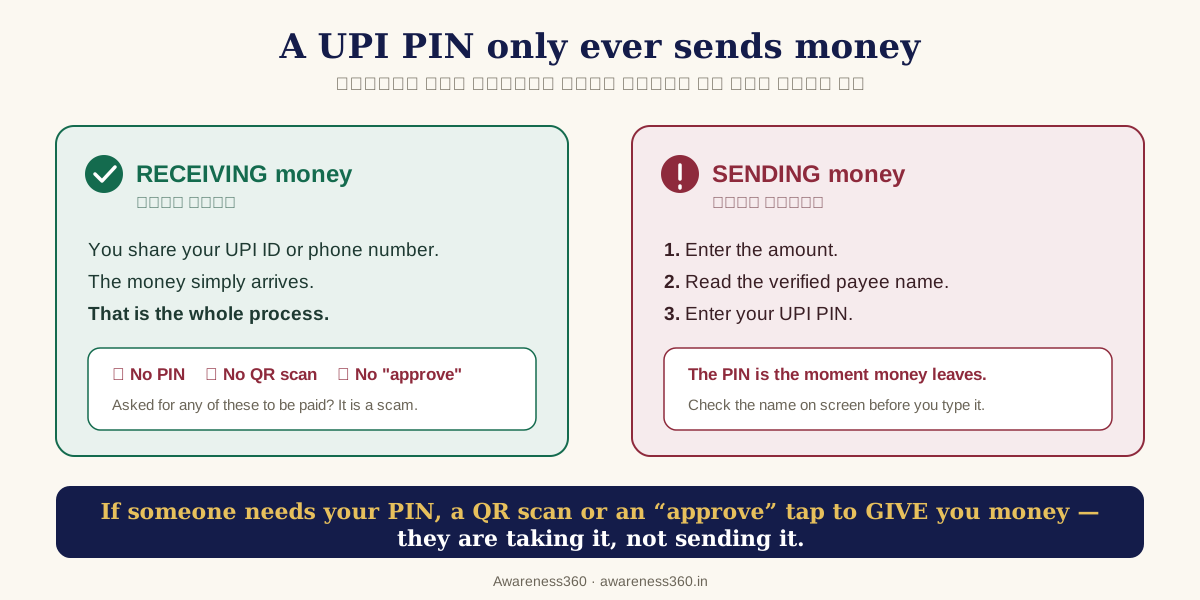
- The QR code you're asked to scan "to receive". Scanning a QR code and entering a PIN only ever sends money. No QR scan is ever needed to receive.
- The screen-sharing app. Fraudsters ask you to install AnyDesk, TeamViewer or similar "so we can help", then watch you type your PIN. No bank asks for this.
- The fake customer care number. A number found through a casual web search — not from your bank's own app, card or passbook — connects you straight to a scammer posing as support. This one catches careful people.
- The OTP or PIN request over a call. No bank, no wallet company, no government department will ever ask for these. Anyone who does is a fraudster, whatever they claim.
The golden rule that defeats all five: you never enter a UPI PIN, scan a QR code, or approve a request to receive money. A PIN is only ever for sending.
Children (Ages 8–14): Learning the Basics Right
Many kids today see their parents tap a phone and money moves. It looks magical — and scammers know that children are curious but not yet cautious.
A common scam scenario: Rohan, 12, sees an ad on a gaming website saying "Send ₹10 via UPI to unlock 500 free game coins!" He uses his mother's phone and makes the payment. The coins never arrive, and the website disappears. The ₹10 seems small, but the scammer runs this trick on thousands of kids.
What children need to know:
UPI is a real tool for real money — not play money. Every transaction is instant and nearly impossible to reverse. The most important rule for children is simple: never use UPI without a parent's permission. If something online asks you to "pay a little to get a lot," it is almost certainly a trick.
Quick Tips for Children
- Always ask a parent or guardian before any UPI payment, even a small one.
- If a game, app, or website asks for money to unlock features, tell an adult first.
- Never share anyone's UPI PIN, even with a friend.
- Remember: receiving money on UPI never requires entering a PIN — only sending does.
Teenagers (Ages 15–19): The Overconfident Zone
Teenagers are digital natives — comfortable with technology, active on Instagram and YouTube, and often the first to try new apps. This confidence can sometimes lead to carelessness.
A common scam scenario: Priya, 17, gets a DM on Instagram from someone claiming to be a brand ambassador recruiter. They say she's been selected for a paid promotion and ask her to pay ₹500 as a "registration deposit" via Google Pay to receive her first assignment worth ₹5,000. She pays. The recruiter vanishes.
What teenagers need to know:
Work-from-home schemes, fake influencer collaborations, online "investment" groups on Telegram, and "cashback if you pay first" offers are all traps designed for teens. Legitimate jobs and brand deals never ask you to pay upfront. Also, be careful about QR codes — scanning a QR code someone sends you can sometimes trigger a payment from your account, not to it.
Quick Tips for Teenagers
- No genuine job or contest asks you to pay to participate. Walk away.
- Treat UPI requests from strangers the same way you'd treat a stranger asking for cash.
- Disable the "auto-pay" feature on UPI apps for services you don't use regularly.
- Use a separate, low-balance UPI account for online purchases if possible.
Young Adults (Ages 20–35): The Busy and the Distracted
Young professionals and students are the biggest UPI users in India. They're also multitasking constantly — and fraudsters exploit that distraction.
A common scam scenario: Amit, 28, posts his flat on OLX for rent. A "buyer" (actually a scammer) calls, says they want to send an advance, and shares a QR code "to confirm Amit's account." Amit scans it and enters his PIN thinking money is coming in. Instead, ₹15,000 is debited from his account. This is one of India's most common UPI frauds — the fake payment request scam.
What young adults need to know:
The golden rule of UPI: you never need to scan a QR code or enter your PIN to receive money. Anyone telling you otherwise is a scammer. Also watch for vishing calls (fake customer care calls from "PhonePe support" or "bank executives") asking for your OTP, PIN, or to install a screen-sharing app like AnyDesk or TeamViewer. Real bank employees will never ask for these.
Quick Tips for Young Adults
- Receiving money requires zero action from you — no PIN, no scan, no OTP.
- Never install any app a stranger asks you to during a call.
- Set transaction limits on your UPI apps for daily spending.
- Check your UPI app's linked accounts section regularly for any unknown additions.
Middle-Aged Adults (Ages 36–55): Trusted Targets
Middle-aged adults often have higher account balances and are targeted with more sophisticated scams — fake KYC updates, income tax refund offers, or impersonation of government officials.
A common scam scenario: Sunita, 45, gets a call from someone claiming to be from the Income Tax Department. They say her PAN card is linked to a fraud case and her UPI account will be blocked unless she pays a ₹2,000 "verification fee" immediately via Paytm. Panicked, she pays. No government agency in India ever collects payments this way.
What middle-aged adults need to know:
Fraudsters often use fear and urgency to bypass your better judgment. The moment a caller says "your account will be blocked" or "act in the next hour or face legal action" — pause. Hang up. Call the official number of the bank or government agency directly to verify. NPCI, the body that runs UPI, will never call you asking for your details.
Quick Tips for Middle-Aged Adults
- Government agencies never ask for payment via UPI. Never.
- If your "KYC" is expiring, visit your bank branch or use the official app — not a link sent on WhatsApp.
- Enable transaction alerts on both your UPI app and bank account for every movement.
- Discuss these scams with elderly parents at home — they need to know too.
Senior Citizens (Ages 55+): The Most Vulnerable Group
Senior citizens are targeted most aggressively because fraudsters assume they are less familiar with technology and more trusting. Scams are often elaborate and emotionally manipulative.
A common scam scenario: Ramesh ji, 67, receives a call from someone claiming to be his grandson's friend, saying his grandson has been in an accident and urgently needs ₹20,000 sent to a specific UPI ID before the hospital will treat him. Distressed, Ramesh ji sends the money immediately. His grandson is perfectly safe — it was a scam built on panic and family love.
What senior citizens need to know:
Always verify before you transfer. Call the person directly — your grandson, your son, your daughter — using the number already saved in your phone. Don't use the number the caller gives you. If someone is helping you use a UPI app, make sure it's someone you fully trust. And remember: once UPI money is sent, it almost never comes back.
One more trap deserves special attention here: never search the internet for a "customer care number". Fraudsters deliberately push fake support numbers high in search results and on social media. Use only the number printed on your bank passbook, on the back of your debit card, or inside the bank's own app.
Quick Tips for Senior Citizens
- Always call back a family member directly to verify any emergency money request.
- Ask a trusted family member to set up and explain your UPI app — never let a stranger help you with it.
- Read the payee's name on the confirmation screen before you approve. The UPI ID can be disguised; the verified name is harder to fake.
- If you feel confused during a call, just hang up. You can always call back yourself.
- Keep UPI transaction limits low — set a daily cap through your bank's app.
If You've Been Scammed: Act Immediately
Time is critical. Here's what to do the moment you realize something is wrong:
- Call 1930 — the National Cyber Crime Helpline, available 24/7. Do this first; the earlier a transaction is flagged, the better the chance of freezing the money before it moves on.
- File a complaint at cybercrime.gov.in and save the acknowledgement number.
- Call your bank's official helpline (from your passbook, card or the bank's own app) and ask them to freeze UPI. Quote the acknowledgement number.
- Put it in writing. Follow the phone call with an email to your bank describing the fraud. A written record is what formally starts the refund and investigation process, and you will need it if you escalate.
- Report the number that called you on Chakshu, at sancharsaathi.gov.in, so the line can be blocked for everyone else.
- Report inside the UPI app — PhonePe, Google Pay, and Paytm all have in-app fraud reporting.
Acting within the first hour significantly improves the chance of your money being recovered.
Universal Safety Checklist: For Everyone
✅ Never share your UPI PIN or OTP with anyone — not even bank employees. ✅ You never need to enter a PIN or scan a QR code to receive money. ✅ Read the verified payee name on the confirmation screen, not just the UPI ID. ✅ Verify any payment request with a direct phone call before sending. ✅ Never search for a customer care number — use the one on your card, passbook or bank app. ✅ Download UPI apps only from the official Google Play Store or Apple App Store. ✅ Keep your phone's screen lock active at all times. ✅ Regularly review your transaction history for anything unfamiliar. ✅ Update your UPI apps — security patches matter. ✅ When in doubt, don't pay. Call 1930 or visit cybercrime.gov.in.
FAQ
Do I ever need to enter my UPI PIN to receive money?
No — never. A UPI PIN authorises money leaving your account. If anyone tells you a PIN, a QR scan or an "approve" tap is needed to receive a payment or a refund, they are trying to take money from you.
Someone sent me a QR code so they can pay me. Is that safe to scan?
No. Scanning a QR code is an instruction to pay, not to be paid. To receive money you only ever need to share your UPI ID or your phone number — nothing you scan or approve.
Can I get my money back after a UPI fraud?
Sometimes, and speed decides it. Call 1930 and file at cybercrime.gov.in immediately, then inform your bank in writing. If the money is still sitting in the fraudster's account it can often be frozen; once it has been withdrawn or moved on, recovery becomes much harder.
The caller knew my name and my bank. Doesn't that prove they're genuine?
No. Names, phone numbers and bank details leak in data breaches and are bought and sold cheaply. Knowing your details proves nothing at all. Verify by calling the bank's official number yourself.
What is the safest single habit to teach an elderly parent?
Hang up and call back. Any genuine matter — from a bank, a hospital, the police, or a relative in trouble — survives a call-back on a number you already have. Urgency that cannot survive a call-back is the scam itself.
UPI is one of India's greatest financial innovations — safe, fast, and powerful when used wisely. Fraudsters count on your hurry and trust. Slow down for just a second, follow these habits, and your money stays exactly where it belongs: with you.
For fraud reporting and cybercrime assistance, call the National Cyber Crime Helpline: 1930 or visit cybercrime.gov.in
How this guide is made
Written and fact-checked by the Awareness360 editorial team from primary sources — RBI, SEBI, IRDAI, the Income Tax Department and Government of India portals — with links to the originals in the text above. Last reviewed on 12 Aug 2026. This is general educational information for Indian readers, not professional financial, legal or tax advice.
Spotted something out of date? Tell us and we'll correct it — see our editorial policy.